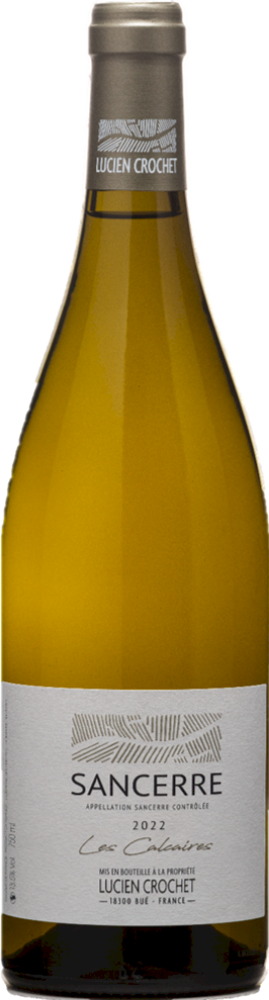
Pours a pale, medium-deep straw with bright hues. On the nose, expect pure expression of chalky minerality, fresh yellow-fleshed stone fruit, and gentle lemongrass with a whisper of toast. The palate is vibrant and lively, with a silky texture and juicy volume balanced by crisp acidity and a subtly savoury finish. The finish remains long, fresh, and structured, showcasing the wine’s refined, mineral core.
“Les Calcaires” is a terroir blend from Lucien Crochet’s limestone-rich plots known as caillottes and griottes, bringing out Sancerre’s signature mineral clarity. The Sauvignon Blanc is vinified traditionally: whole-bunch pneumatic pressing, cold settling, fermentation in temperature-controlled stainless steel, and extended lees-aging (up to 17 months) to enhance depth and texture without weight.
Serve chilled (10–12 °C). Perfect with goat's cheese (especially Chavignol), gently seasoned fish, shellfish, or as a refreshing aperitif that complements the wine’s vibrant minerality and citrus precision.
Wine characteristics
France
Sauvignon Blanc
2022
Lucien Crochet
13.5%
Standard - 75cl
Cork
Tips
How to serve?
Serve chilled
Goes well with
Aperitif
Goes well with
Asian
Goes well with
Cheese
Goes well with
Fish
Goes well with
Poultry
Goes well with
Shellfish
Goes well with
Tapas
Discover
Both of Gilles Crochet's grandfathers, André Crochet and Lucien Picard, were winegrowers. In fact, in the early 1950s, Lucien Picard was one of the pioneers of bottling Sancerre wines in the region to be able to sell them in Paris. Gilles' father, Lucien Crochet, merged the two estates together. He developed relationships with the finest restaurants in Paris and it was only natural for the export markets to follow. Today, Gilles' wife Laurence, who is also the daughter of a Sancerre grower, oversees the estate.
Their vineyards cover an area of 35 hectares, 26 of which are planted with Sauvignon Blanc grapes for white wines and 9 hectares with Pinot Noir for red and rosé. Most of the vines are in Bué, though they also have plots in the adjacent communes of Sancerre, Crézancy and Vinon. The value of the vineyards is linked to their soils, which overlie calcareous clay rock and an Oxfordian or Kimmeridgian subsoil. These plots are located on east, south and west-facing slopes at altitudes varying between 240 and 280 metres, which allows them to harvest the grapes when they are at their optimum peak of ripeness.
Related articles
Reviews
We value your opinion!
Please take a moment to leave a review and help others choose the perfect product.